What the expanded review found
Japanese product information, a clear next step and an identifiable Japan operator are separate things to check. In the added 142-record review, 34 records had a Japanese product and use-case explanation, 26 exposed a clear Japanese next step, and 11 clearly identified Japan operating responsibility. These groups can overlap; they are not successive steps in a funnel.
The Japan Buyer Evidence Index now covers 204 completed company-record reviews: 62 in Stage 1 and 142 in Stage 2. This expands the work behind our earlier 50-company feasibility post. The pilot is not an additional 50 records, and 204 is not the full exhibitor population.
We also assessed Japanese text separately. Of 55 records selected because the earlier review found full or partial Japanese product information, 54 had assessable text. The AI editorial assessment flagged grammar issues in 9 and naturalness issues in 34. Those categories overlap, and an awkward sentence is not necessarily ungrammatical. These are observations about selected passages, not certifications of whole websites.
For a team managing a Japan-facing B2B website, the practical use is to choose what to inspect: product explanations, contact routes, assurance information, operating responsibility and customer or partner evidence. This study does not measure sales, search rankings or AI citations.
Five checks, with the two stages kept separate
The tables retain every record in each stage and show missing observations explicitly. They count records, not pages, customers or conversions.
- Yes: the observed evidence met that field's definition.
- Partial: relevant information was visible but incomplete or ambiguous under the definition.
- Global only: qualifying assurance information was found only outside the Japanese layer. This category applies to assurance information.
- No: the sampled visible evidence supported a negative classification under that field's definition. It does not establish a company-wide absence.
- Not observed: the page could not be assessed, the question remained unresolved, or no qualifying evidence was found. This is not interchangeable with “no.”
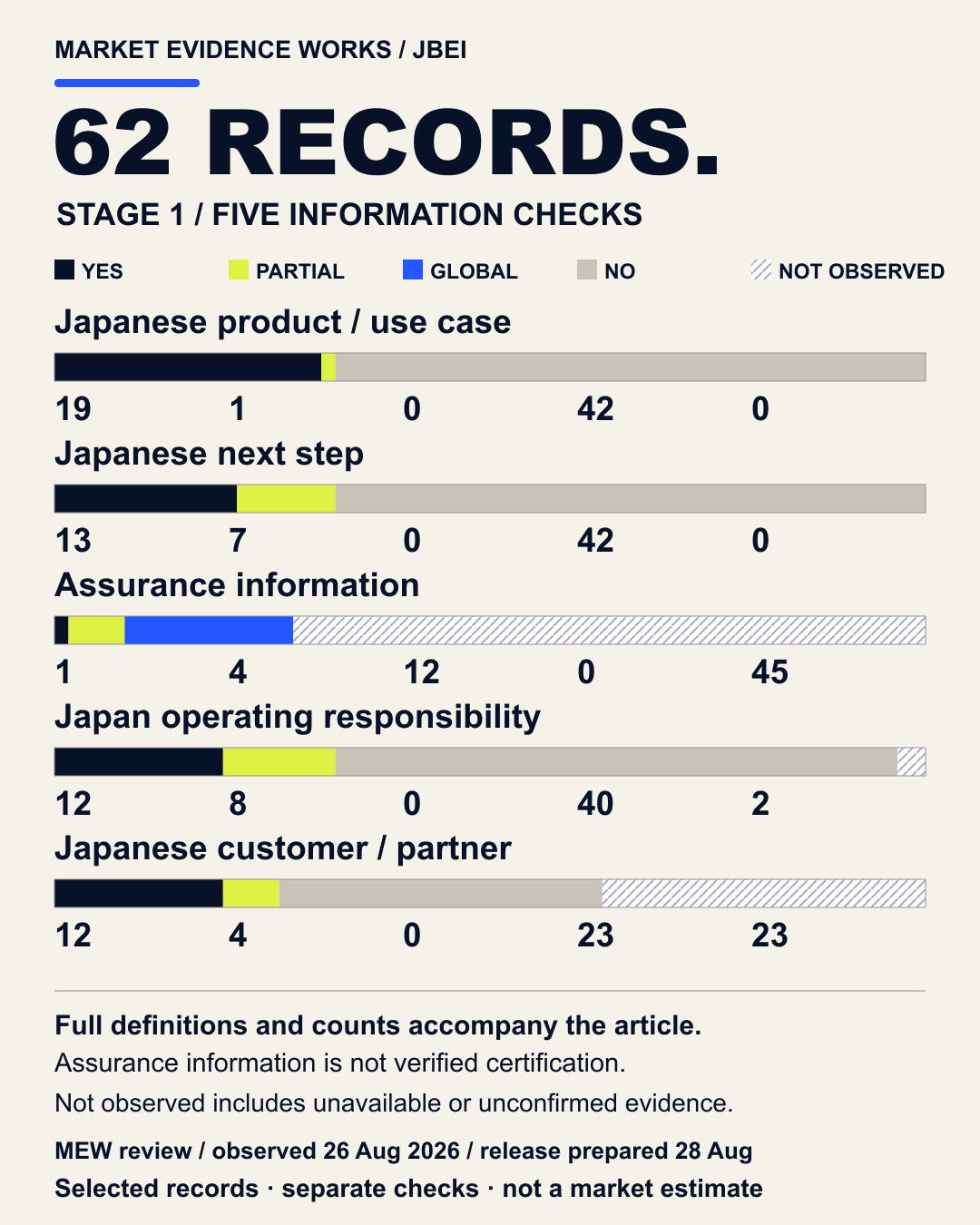
Stage 1: 62 records, observed 26 August 2026
On small screens, scroll the table horizontally. All figures are counts of records.
| Information checked | Yes | Partial | Global only | No | Not observed |
|---|---|---|---|---|---|
| Japanese product / use case | 19 | 1 | 0 | 42 | 0 |
| Japanese next step | 13 | 7 | 0 | 42 | 0 |
| Assurance information | 1 | 4 | 12 | 0 | 45 |
| Japan operating responsibility | 12 | 8 | 0 | 40 | 2 |
| Japanese customer / partner | 12 | 4 | 0 | 23 | 23 |
Stage 2: 142 additional records, observed 27 August 2026
On small screens, scroll the table horizontally. All figures are counts of records.
| Information checked | Yes | Partial | Global only | No | Not observed |
|---|---|---|---|---|---|
| Japanese product / use case | 34 | 1 | 0 | 103 | 4 |
| Japanese next step | 26 | 9 | 0 | 102 | 5 |
| Assurance information | 12 | 8* | 41* | 0 | 81 |
| Japan operating responsibility | 11 | 13 | 0 | 99 | 19 |
| Japanese customer / partner | 20 | 12 | 0 | 48 | 62 |
Assurance counts include a dated correction: two original global-only classifications were moved to not observed because the saved evidence did not meet the substantive-information threshold. One retained partial classification and one retained global-only classification still have unresolved scope judgments. The categories describe visible information, not independently verified certifications. If those two retained judgments were also set aside, the corresponding counts would be 7 partial, 40 global only and 83 not observed; the 12 yes classifications would be unchanged.
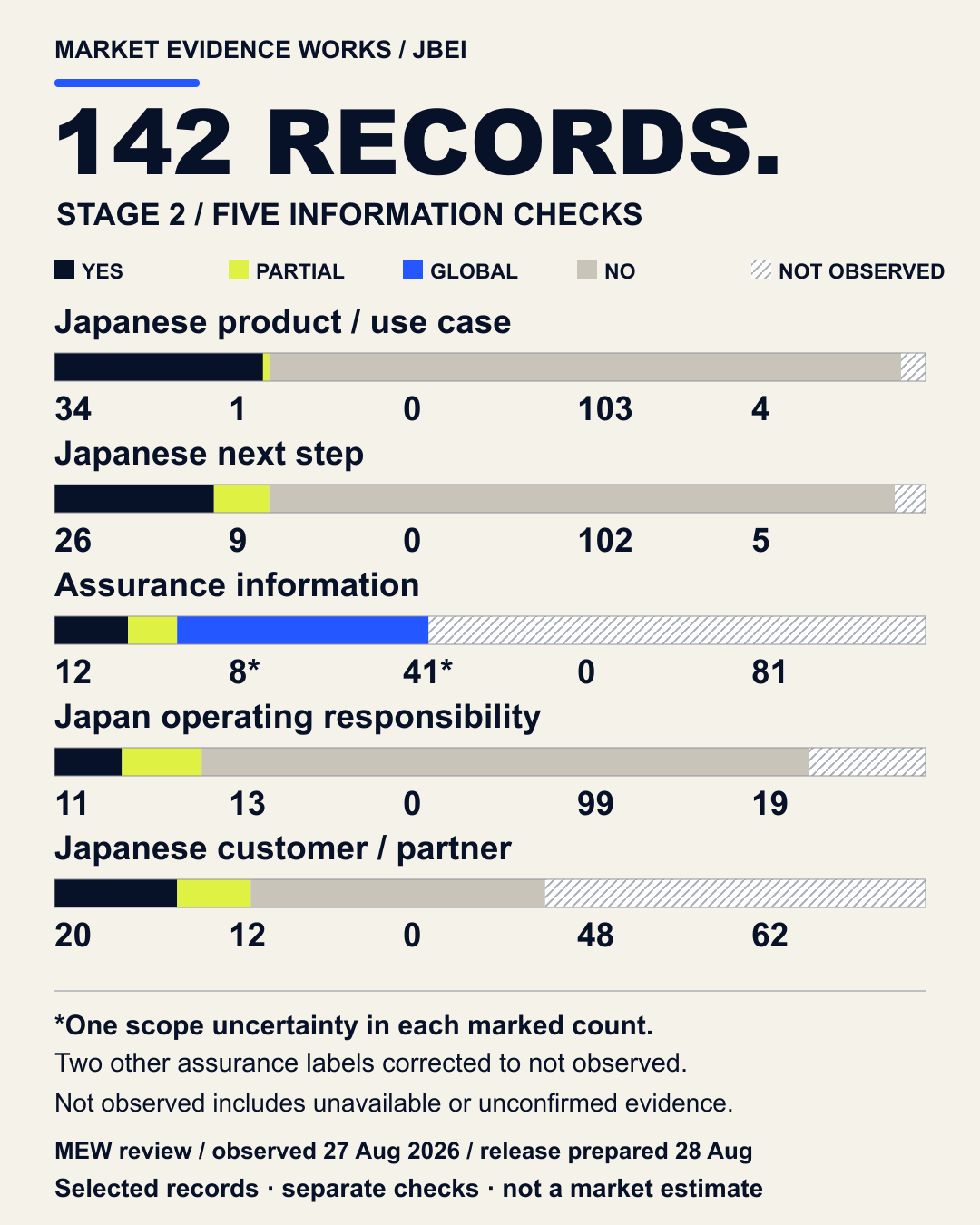
Source for both tables and charts: MEW's dated review records, using the frozen 26 August field definitions and the 28 August correction overlay. Anonymous aggregate data accompany this supplement. The two stages cover different selected groups and dates, so differences between them are not a trend or a country comparison.
How to read the five checks
Product and use case means that the observed Japanese rendering explains what the offer does and at least one use case. Availability does not establish the quality of its Japanese.
Next step means that the Japanese rendering exposes a clear route such as pricing, a trial, a demo or contact. It does not establish that a form can be successfully submitted, that a reply will arrive in Japanese, or that a local team will deliver the service. No inquiries or trials were submitted.
Assurance information covers substantive vendor assurance, certification, trust or procurement information. A privacy-policy link or a generic security statement is insufficient by itself. The field is broader than information-security certification and does not validate the currency, applicability or legal effect of every claim.
Japan operating responsibility means a clearly identified Japan entity, office, support owner, distributor or implementation owner. A Japanese page alone does not identify who will handle the account.
Japanese customer or partner means that a named Japanese customer or partner and the relationship are visible. This can include a published relationship or support arrangement; it does not establish deployment in Japan, a paid contract, current usage or revenue.
Japanese quality: a separate assessment of selected text
The quality pass selected all 55 records coded yes or partial for Japanese product information: 20 from Stage 1 and 35 from Stage 2. It did not select only pages that looked problematic. One Stage 1 record had no assessable Japanese text. The other 149 records were not assessed for language quality; they are not counted as error-free.
The table shows records with an issue / records assessed. The last column reports unassessed records within the 55-record selection. Different dimensions can flag the same record, so the rows must not be added together.
On small screens, scroll the table horizontally. All figures are counts of records.
| Dimension | Stage 1 | Stage 2 | Combined work count | Not assessed |
|---|---|---|---|---|
| Grammar | 2 / 19 | 7 / 35 | 9 / 54 | 1 |
| Orthography and written form | 4 / 19 | 7 / 35 | 11 / 54 | 1 |
| Naturalness | 8 / 19 | 26 / 35 | 34 / 54 | 1 |
| Terminology consistency | 1 / 19 | 5 / 35 | 6 / 54 | 1 |
| Language continuity along the journey | 12 / 17 | 19 / 35 | 31 / 52 | 3 |
| Meaning against source-language text | Not assessed | 1 / 1 | One paired passage only | 54 |
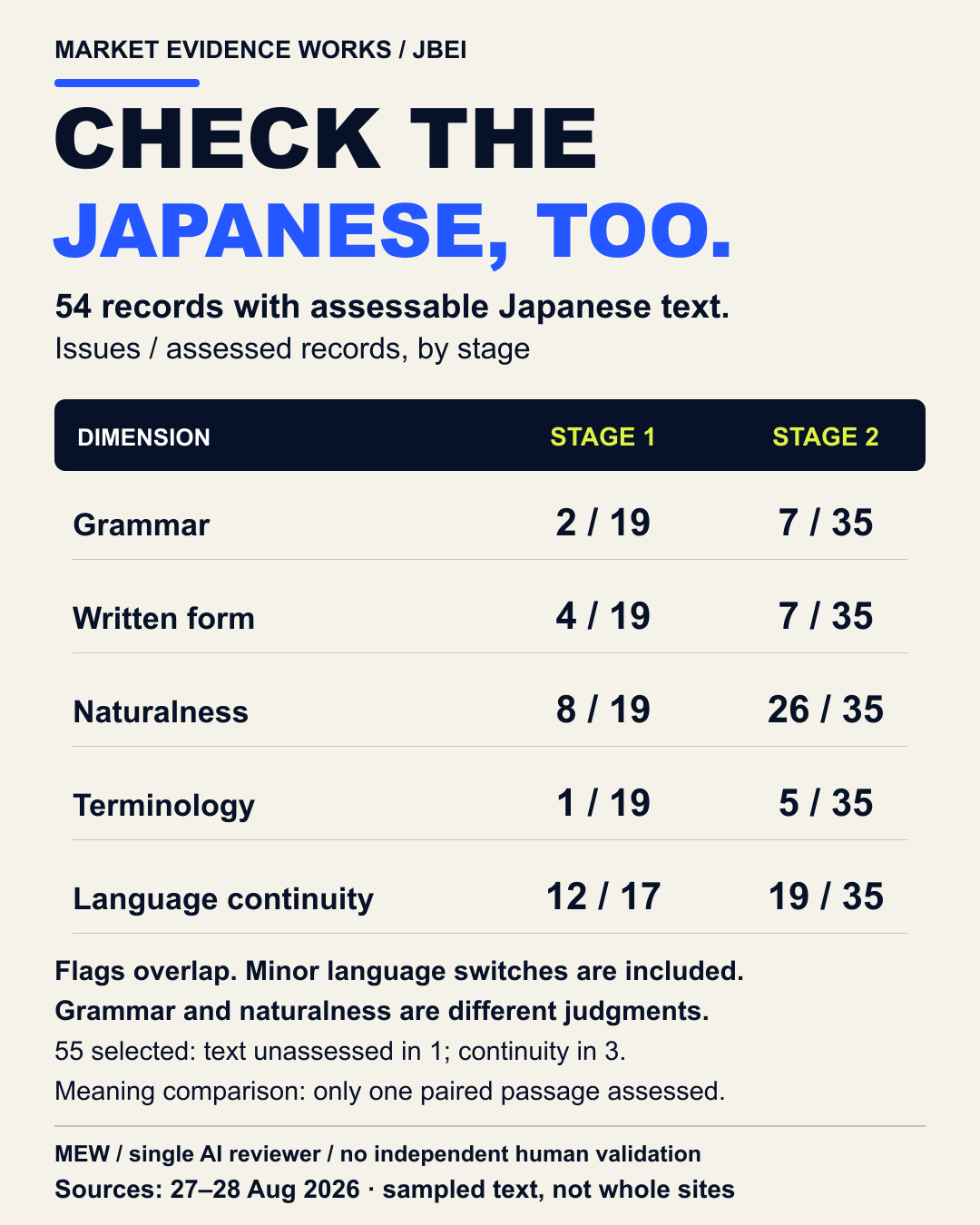
Source: MEW's 28 August AI editorial assessment, using Stage 1 captures from 28 August and saved Stage 2 observations from 27 August. A “no obvious issue” judgment applies only to the inspected material. Review depth and available routes varied; these counts are not estimates of market prevalence or evidence that one stage has better Japanese than the other.
Grammar checks considered sentence structure and grammatical relationships. Naturalness covered phrasing that sounded literal, awkward or poorly suited to the reader. Orthography and terminology were recorded separately. We did not classify an accepted Japanese omission as a grammar error merely because a longer form was possible.
Continuity findings include minor untranslated controls, accessible operation names and country choices, as well as language changes along a route. 31 flags do not mean 31 unusable contact journeys. Meaning was checked against a source-language passage in only one case; this is not a translation-accuracy audit of the sample.
These judgments were made by a single AI reviewer. They have not received independent human validation and should be read as disclosed editorial assessments, not settled judgments about individual companies.
What to inspect on your own site
Our interpretation is that these results support a more specific audit than asking whether a site “has Japanese.” Start with a product page and follow the route a potential buyer would take.
- Read the explanation. Does it explain the product and a relevant use case? Check grammar, written form and naturalness separately.
- Follow the next step. Inspect the language of pricing, demo and contact pages, including instructions and controls. Record what remains untested.
- Find assurance information. Check whether the material is substantive and whether its scope, date and relevance are clear. A link alone is not the answer.
- Identify responsibility. Can the reader tell who handles sales, implementation or support in Japan?
- Clarify the relationship evidence. Explain whether a displayed organisation is a customer, partner, distributor or supporter, without implying outcomes the source does not show.
This is an interpretation of the observed information gaps, not a tested intervention or a predicted uplift. The Japan-ready B2B website checklist provides a practical companion to the results.
Selection, dates and limitations
The starting source was the official SusHi Tech Tokyo 2026 exhibitor directory and its exhibitor workbook, retrieved on 25 August. The screening rules focused on non-Japan companies in eligible company categories, with public websites, a B2B technology or technology-enabled offer and sufficient English material for the rubric. The 298-record candidate ceiling is not a completed-review denominator.
Stage 1 began with 86 website-bearing candidate records from the United States, Canada, United Kingdom, Ireland, Singapore and Australia. Its 74-record eligible frame comprised the original 50 pilot records and 24 additions; 12 candidates were excluded. A 26 August collection returned analysable HTML for 62 records, which received the five-field review. The remaining 12 had access or transport outcomes and were outside that 62-record review.
Stage 2 extended the candidate frame beyond those initial markets. Its 212 source records were partitioned into 142 included, 28 excluded, one duplicate and 41 with unresolved eligibility or access restrictions. The 142-record operational frame received the five-field review on 27 August. Completion means each record received a classification, which may include not observed; it does not mean every page or field was assessable.
The quality follow-up used 117 saved evidence or attempt files covering 113 distinct recorded URLs. These are not 117 unique pages or 113 fully inspected journeys. Stage 1 text was captured on 28 August; Stage 2 text came from saved 27 August observations. This release does not claim that all 204 websites were revisited on 28 August.
The study measures the public material that was observed. Event-based selection, access restrictions, English-language eligibility and unequal inspection depth limit generalisation. Neither country rankings nor a composite readiness score are reported.
Review and anonymity
Earlier pilot communications proposed an independent review. This expanded descriptive release does not claim that review has happened: it uses a single AI reviewer, with source, arithmetic and editorial checks. Independent human validation has not been completed.
We publish aggregate counts and definitions without company names, individual URLs, identifying excerpts, screenshots or record-level downloads. Source records and correction history are retained internally. This protects anonymity but limits readers' ability to independently reproduce individual judgments. No company-specific ranking or quality claim is made.
The original Stage 1 working paper remains the historical record. This dated supplement adds Stage 2, the disclosed assurance correction and the separate Japanese-quality assessment; it does not silently replace earlier results.